
Have you ever found yourself needing to make a crucial decision, support your opinion in a discussion, or persuade a customer in a meeting?
Whether you’re choosing a new project direction, debating a topic with friends, or negotiating a deal, the strength of your argument can make all the difference
In these moments, your ability to think critically and construct solid arguments is essential. Critical thinking enables you to evaluate information, weigh evidence, and present compelling reasons for your beliefs. By understanding how to form effective arguments, you not only support your opinions but also enhance your decision-making skills and influence others.
So, how does this all play out in real life? Let’s look at a few examples you’ll recognize.
Critical Thinking in Action: Real-Life Scenarios

Scenario 1: Choosing a College
Situation: You’re deciding which college to attend.
Critical Thinking: Instead of just going to the college your friends are attending, you research each college’s programs, campus culture, and job placement rates. You compare the pros and cons of each option, asking yourself questions like, “Does this college offer the major I want?” and “What do current students say about their experience?”
Outcome: By evaluating the information, you make a more informed decision that aligns with your goals.

Scenario 2: Evaluating News Articles
Situation: You read a news article that makes a surprising claim.
Critical Thinking: Instead of immediately believing it, you ask questions like, “What evidence is provided?” and “Are there other sources that confirm this information?” You might check multiple news outlets or look for expert opinions on the topic.
Outcome: By critically evaluating the claims, you avoid spreading misinformation and understand the issue better.

Scenario 3: Buying a Car
Situation: You’re in the market for a used car and see a great deal online.
Critical Thinking: Rather than rushing to buy it, you research the car’s history, read reviews, and compare prices for similar models. You also consider factors like maintenance costs and fuel efficiency.
Outcome: By thinking critically, you avoid potential pitfalls and make a choice that fits your needs and budget.
In each scenario, critical thinking helps you make better decisions by ensuring that your beliefs and choices are based on solid reasons and evidence. It involves asking questions, gathering information, and evaluating what you find, rather than simply accepting things as they are
Those examples show how useful critical thinking can be day-to-day, but what exactly is it, and why does it matter?
Why Good Reasons Matter: Understanding Critical Thinking
Critical Thinking focuses on ensuring that your beliefs are supported by strong reasons and involves evaluating good versus bad reasons for those beliefs. Rational individuals strive to hold true beliefs rather than false ones.
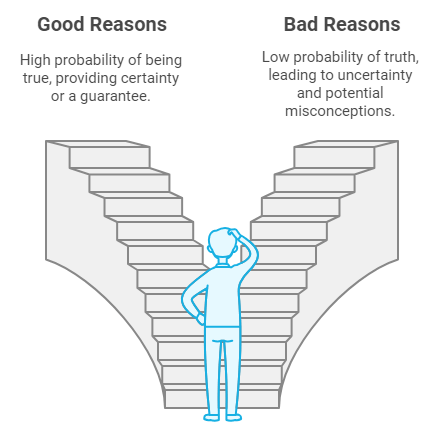
When you distinguish between good and bad reasons for believing something, you exercise your critical thinking skills.
At the heart of critical thinking is the ability to build solid arguments. Let’s break down what makes a good one.
What Makes a Strong Argument?
Argument a set of statements (premises) that together comprise a reason for a further statement (the conclusion).
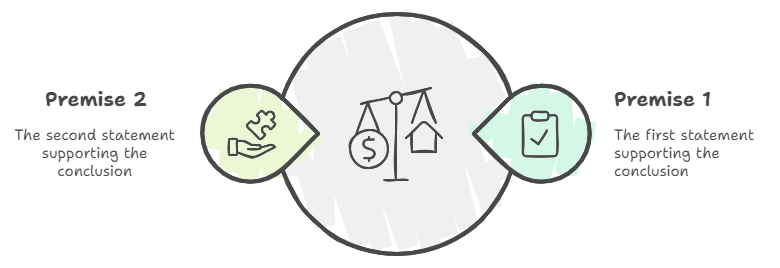
Premise 1:
Premise 2:
————
Conclusion :
Good argument has premises that make the the conclusion likely to be True (The premises support their conclusion)-> Give you a good reason for believing the conclusion. A bad argument doesn’t support their conclusion.
Now that we know what an argument is, let’s talk about three types of reasoning that help us get to solid conclusions
Three Types of Reasoning: Deductive, Inductive, and Abductive
When evaluating arguments, it’s essential to understand the different ways we can arrive at conclusions. Here, we’ll explore three primary types of reasoning: deductive, inductive, and abductive arguments.
Deductive Argument
Premise 1: if true
Premise 2: if true
——————
Conclusion: Must be true (guaranteed)
The truth of the premises quarantines the truth of the conclusion (Deductive argument)
Example:-
Premise 1: If it is raining, the ground will be wet.
Premise 2: It is raining.
————————
Conclusion: Therefore, the ground is wet. <- No new information is introduced
Here, the truth of the premises guarantees the truth of the conclusion.
A deductive argument is a type of reasoning in which the conclusion necessarily follows from the premises. If the premises are true and the reasoning is valid, the conclusion must also be true. Unlike ampliative arguments, where the conclusion extends beyond the premises, deductive reasoning aims to confine the conclusion within the information provided in the premises. In a deductive argument, no new information is introduced in the conclusion; rather, it logically follows from the premises with certainty, rather than probability.
Deductive reasoning is pretty airtight, but ampliative arguments are more about likelihood—let’s see how that works
Inductive Argument
Premise 1: if true
Premise 2: if true
——————
Conclusion: Possibly false (probable) not guaranteed
The truth of the premises doesn’t guarantee the truth of the conclusion (Ampliative argument)
Example:-
Premise 1: The sun has risen every day in the past.
Premise 2: Today is another day.
———————————-
Conclusion: Therefore, the sun will rise tomorrow. <- Amplifies or goes beyond the content of the premises
While this conclusion is likely true, it is not guaranteed because it’s possible (though unlikely) that something unexpected could happen.
An Inductive (Ampliative) argument is a type of reasoning in which the conclusion extends beyond the information provided in the premises. Unlike deductive reasoning, where the conclusion is necessarily true if the premises are true, ampliative arguments aim to provide probable support for the conclusion, but the conclusion is not guaranteed. In other words, the conclusion amplifies or goes beyond the content of the premises, introducing new information or possibilities.
Abductive Argument
Premise : Observations or evidence
————————————–
Conclusion: Best explanation (reasonable, not guaranteed)
The conclusion is the most likely explanation based on the given evidence, but it’s not guaranteed to be true.
Example:-
Premise : The grass is wet.
—————————-
Conclusion: Therefore, it probably rained last night. <- An inference
In this example, the conclusion is an inference based on the evidence of the wet grass. While it’s a plausible explanation, there could be other reasons for the wet grass, such as someone watering the garden.
Abductive reasoning focuses on finding the best explanation for observations, making it a crucial part of our critical thinking toolkit.
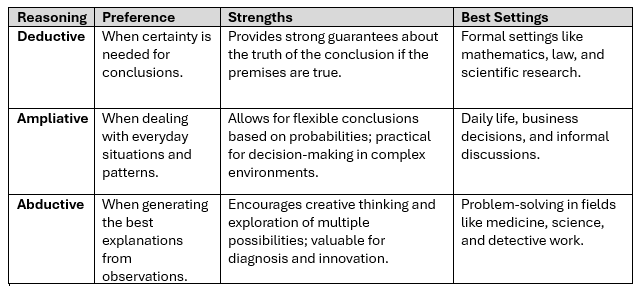
Strengths and Applications of Different Types
Like listening better? Check out the podcast version below!
 Beyond Cloud Nine
Leave a comment